Read the publication: access the full article “After Yechury: Notes from a Taluka Sabha” as a downloadable PDF below.
After Yechury: Notes from a Taluka Sabha
After Yechury: Notes from a Taluka Sabha
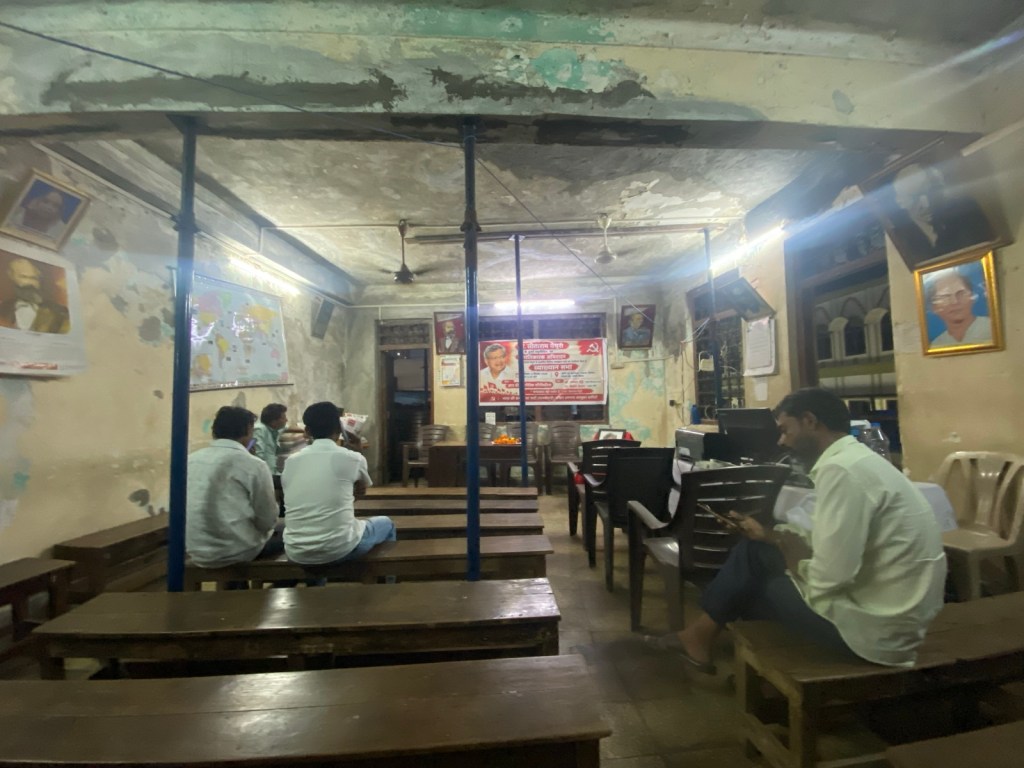
A map of the world hangs on one side of the room; what holds my attention is the sheer size of the atlas, trying to cover the damp walls. I can sure imagine any communist office in any part of the world not having the map of its own country but the world, like so. Everyone who could make it was on time, but the sabha was delayed by half an hour, with hopes for more respect. No one else joined.
The teapot has been boiling since evening, and everyone gratefully sipped through the wait.
It is Comrade Sitaram Yechury’s second death anniversary today; everyone from the CPIM and CITU in the taluka was expected to pay homage. It was mostly the leaders and the committee members who may have known more about the sacrifices of Comrade Yechury that turn up. Everyone, by looks, should have felt out of place, but they were certain they were in the right place. Each one in that room had conviction. Conviction to change the existing state of affairs, although everyone seemed to be hanging by a thread and had no clue where to turn after the Comrade’s demise, managing to have settled nerves. Because, for the communists, it has always been the same.
It was made clear by the leadership that the party has no intent to gain power, but rather to continue to hold its position and question those in power.
The Constitution of India clearly states that we are a Socialist Republic, yet today we see a systematic disintegration of the remnants of the socialist fabric. Decade by decade, the broader meaning of socialism has narrowed down between the pages of the Constitution. Words, however profound, can only be transcribed through action. Here, there is a clear misalignment between the words and action.
The thought here is not to prosper the Socialist Republic of India, but to sell it off to the lowest bidder. Ironically, that’s how crony capitalism works. The buyer bids the lowest because there is more price paid for control over the whole bargain. That extra price is a bag of gold for the powerful, well tucked under their waistcloth.
This is exactly what our forefathers feared: their bloodline handing over the destiny of our country to communalism. Well, under the garb of nationalism, a pseudo-religion under the current regime is taking shape. There is a bitter aftertaste from the partition among Indians, which is constantly misappropriated as a reason to equalise with our neighbours by spreading hatred against muslims and terming them as second-class citizens.
In the final days of Comrade Yechury, it was made clear by him how communalism is a tool that self-loathing goons use to gain power and hold it, and sell the resources of the country off to whoever favours them.
During the sabha, Comrade Prabhakar Shetty pondered on what Comrade Yechury would have said about public policy, two years after his demise.
Everyone first offered their respects to Comrade Sitaram Yechury by offering flowers. Comrade Anju opened the sabha, and Comrade Ravi threw light on the life of Comrade Sitaram Yechury thereafter. Comrade Prabhakar Shetty later began by saying that there is a need for the party not to give long speeches, but to have more work done in effect. Today we were all gathered to feel brotherhood and sisterhood, and offer our respects for the loss we all feel together. The loss of a voice for the people who are facing the extremes with little to gain from it. The disparity between the common and the devious has reached its limits.
— Com. Abhishek Menon
 Left Central
Leave a comment